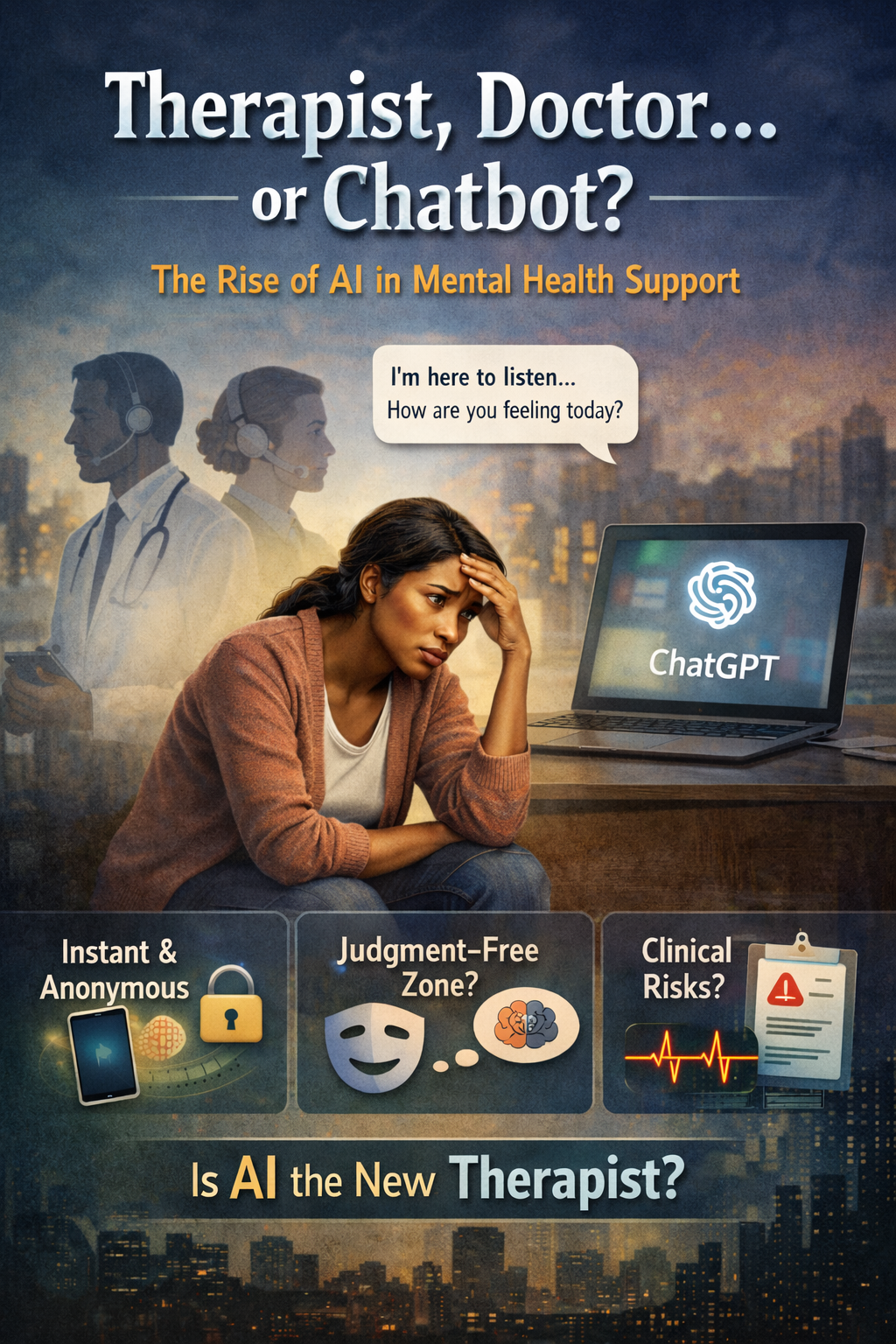
Therapist, Doctor… or Chatbot?The Rise of Conversational AI in Mental Health Care and Its Clinical Implications
By Dr. Nozithelo Moyo
Abstract
The increasing use of conversational artificial intelligence (AI) for mental health support is reshaping how individuals access care. Many users are now turning to general AI platforms instead of telemedicine services or dedicated mental health applications. While this shift improves accessibility and reduces stigma, it raises concerns regarding clinical safety, diagnostic accuracy, and continuity of care. This article explores current evidence, user behavior trends, and the implications for healthcare systems, pharmaceutical companies, and medical technology innovators, with a focus on global and African contexts.
Introduction
Mental health disorders remain a leading contributor to the global burden of disease. According to the World Health Organization (WHO), depression affects approximately 280 million people worldwide, and suicide accounts for over 700,000 deaths annually. Despite this burden, significant treatment gaps persist, particularly in low- and middle-income countries where up to 75% of individuals receive no formal care.
At the same time, artificial intelligence has rapidly evolved beyond clinical applications into everyday use. Increasingly, individuals are using AI tools to process emotions, seek advice, and navigate psychological distress. This represents a major shift away from traditional care pathways, including telemedicine consultations and structured mental health apps.
The Shift from Telemedicine to Conversational AI
Accessibility and Immediacy
Telemedicine services often require appointments, consultation fees, and waiting periods. In contrast, conversational AI offers immediate, real-time responses and is available 24/7. This level of accessibility makes AI particularly appealing for individuals seeking instant emotional support.
Stigma and Psychological Safety
Mental health stigma continues to prevent many individuals from seeking professional help. Even in telemedicine settings, patients may fear judgment, confidentiality breaches, or cultural stigma.
AI platforms provide a perceived judgment-free environment, allowing users to express themselves more openly. However, stigma remains complex—some individuals may still struggle to fully open up, even to digital systems, limiting the effectiveness of these tools.
Conversational Flexibility vs Structured Care
Dedicated mental health applications such as Woebot and Wysa are built on evidence-based frameworks like cognitive behavioral therapy (CBT). While clinically effective, these platforms can feel structured and limited.
Conversational AI, on the other hand, offers more natural, flexible, and human-like interactions. Users can discuss a wide range of topics without being confined to predefined modules, making the experience feel more personal and engaging.
Evidence from Recent Research
Recent studies highlight both the potential and limitations of AI in mental health care:
- AI-based CBT chatbots have demonstrated reductions in symptoms of depression and anxiety, particularly in mild-to-moderate cases
- Machine learning models can assist in early detection of mental health deterioration through behavioral analysis
- AI systems show promise in identifying suicide risk with higher sensitivity than traditional screening tools
However, challenges remain:
- Limited long-term outcome data
- Lack of real-world validation across diverse populations
- Underrepresentation of African and low-resource settings in training datasets
Clinical Perspective
From a medical standpoint, AI should be considered a supportive tool rather than a replacement for clinicians.
Benefits
- Encourages early help-seeking behavior
- Provides immediate emotional support
- Reduces burden on healthcare systems
- Expands access in underserved regions
Risks
- No formal diagnostic capability
- Potential misinterpretation of serious symptoms
- Lack of crisis intervention support
- Absence of continuity in patient care
Mental health care relies heavily on human empathy, trust, and cultural understanding—elements that AI cannot fully replicate.
The African Context
Mental health services across Africa remain limited, with severe shortages of trained professionals in many regions.
Opportunities
- Mobile-based AI platforms can reach remote populations
- Anonymity may help reduce stigma
- Scalable solutions for large populations
Challenges
- Limited internet access and digital literacy
- Cultural and linguistic gaps in AI systems
- Persistent stigma around mental health
- Reluctance to share personal experiences, even digitally
While AI can reduce barriers, it is not a complete solution without localization and cultural adaptation.
Implications for Medical Technology and Pharmaceutical Industries
Medical Technology Companies
- Opportunity to integrate conversational AI into telemedicine platforms
- Development of hybrid care systems combining AI and clinicians
- Focus on user experience and emotional engagement
Pharmaceutical Industry
- Use of AI for patient education and adherence monitoring
- Collection of real-world data to support drug development
- Integration of digital therapeutics with pharmacological treatments
Ethical and Regulatory Considerations
The use of AI in mental health raises important ethical concerns:
- Protection of sensitive patient data
- Risk of algorithmic bias
- Lack of regulatory oversight in many regions
- Accountability for AI-generated advice
Strong regulatory frameworks will be essential to ensure safe and equitable use.
Future Directions
The future of mental health care lies in integration:
- AI as a first point of contact
- Clinicians providing diagnosis and treatment
- Systems that allow seamless transition from AI to human care
This hybrid model combines accessibility with clinical expertise.
Conclusion
The growing reliance on conversational AI for mental health support reflects a shift in patient priorities toward accessibility, immediacy, and emotional safety.
While AI has the potential to bridge gaps in care, it cannot replace professional medical support. The challenge moving forward is to build healthcare systems that are as accessible and user-friendly as AI, while maintaining clinical safety and effectiveness.
References
- World Health Organization. Mental health: strengthening our response. 2023.
- Fitzpatrick KK, Darcy A, Vierhile M. Delivering cognitive behavioral therapy via conversational agents. JMIR Mental Health. 2017;4(2):e19.
- Topol EJ. High-performance medicine: the convergence of human and artificial intelligence. Nature Medicine. 2019;25(1):44–56.
- Rajkomar A, Dean J, Kohane I. Machine learning in medicine. New England Journal of Medicine. 2019;380(14):1347–1358.