Ebola Beyond the Headlines
Part II: “Fear Travels Faster Than Viruses”What Ebola outbreaks reveal about fear, misinformation, and global health narratives.
By Nozithelo T. Moyo, MBBS | Medical Doctor & Health Writer
Outbreaks are never purely biological events.
Long before a virus crosses a border, fear often travels first through headlines, social media posts, rumours, and collective anxiety. Few diseases demonstrate this more clearly than Ebola virus disease.
Decades after the virus was first identified, the mere mention of “Ebola” still triggers a uniquely visceral reaction across the world. Flights are questioned. Borders tighten. Communities panic. Images of hazmat suits and isolation wards dominate media coverage almost immediately.
And yet, understanding why Ebola terrifies the world requires looking well beyond the virus itself.
Why Does Ebola Generate So Much Fear?
Part of the fear is understandable. Ebola virus disease is severe, potentially fatal, and in its worst presentations physically devastating. The Bundibugyo strain responsible for the current outbreak carries an estimated case fatality rate of 25%–40%. That is a number that demands respect.
But biology alone does not explain the scale of global panic Ebola consistently produces.
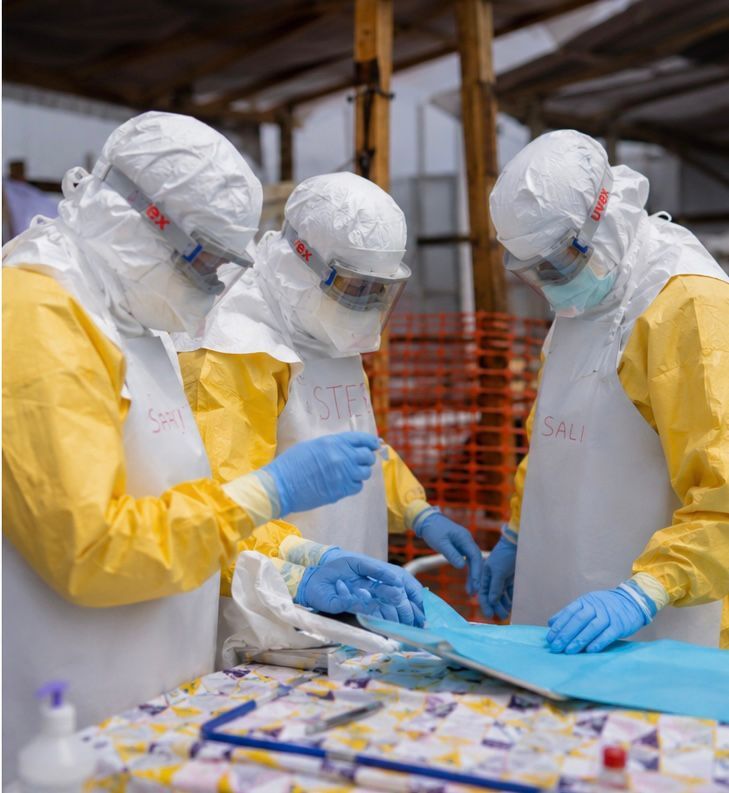
Fear is also shaped by visibility. Unlike many infectious diseases that progress quietly, Ebola outbreaks are highly visible and emotionally confronting. Isolation units, full personal protective equipment, and strict burial procedures create imagery that leaves a deep psychological imprint on local communities and international audiences alike. The enforced distance between the sick and their families necessary as it is carries its own kind of horror.
The unpredictability of outbreaks compounds public anxiety further. Ebola outbreaks often emerge suddenly, sometimes in regions already experiencing healthcare strain, armed conflict, displacement, or economic collapse. In those moments, uncertainty becomes fertile ground for fear and for misinformation.
When Misinformation Becomes Its Own Epidemic
During outbreaks, false information can spread as fast as and sometimes faster than the virus itself.
This is not an abstraction. During the 2018–2019 Ebola epidemic in North Kivu and Ituri, which ultimately became the second-largest Ebola outbreak in history, researchers published population survey findings in The Lancet Infectious Diseases examining public perceptions in the epicentre cities of Beni and Butembo.
Among 961 respondents:
- 25.5% believed the Ebola outbreak was not real
- 32.6% believed it had been fabricated for financial gain
- 36.4% believed it had been fabricated to destabilise the region
Low institutional trust and belief in misinformation were directly associated with lower acceptance of preventive behaviours, including vaccine uptake and willingness to seek formal healthcare.
The consequences were not merely statistical. More than 300 attacks on Ebola health workers were recorded in 2019 alone, leaving six dead and 70 wounded. The resulting insecurity significantly disrupted outbreak containment efforts.
These dynamics matter for the current situation in Ituri the same province where the 2018–2019 epidemic unfolded. Outbreak control depends entirely on public cooperation:
- people must report symptoms
- seek medical care
- allow contact tracing
- trust that healthcare facilities are places of treatment rather than places of death
Where that trust is absent, containment fractures.
This is why outbreak response is not only a medical undertaking. It is also fundamentally one of communication, transparency, and earned public confidence.
The Burden Carried by Healthcare Workers
Behind every Ebola outbreak are healthcare workers operating under extraordinary pressure physical, psychological, and often morally exhausting.
In the current outbreak, the virus’s impact on healthcare workers was visible from its earliest stages. The first suspected case was reportedly a healthcare worker who developed symptoms in late April 2026 and later died at a medical centre in Bunia. The initial alert sent to the World Health Organization on 5 May also referenced deaths among healthcare workers as one of the defining early warning signals of the outbreak.
As of mid-May, several healthcare worker deaths had already been reported in circumstances suggestive of viral haemorrhagic fever transmission within healthcare settings, raising serious concerns about infection prevention and control gaps.
This pattern is not new. During the 2018–2019 North Kivu epidemic, hundreds of healthcare workers became infected, some while providing care without adequate protective equipment.
But healthcare worker vulnerability during outbreaks is not simply a product of the virus itself. It is also shaped by conditions that existed long before the outbreak began:
- chronic staffing shortages
- inadequate protective equipment
- underfunded healthcare systems
- burnout
- delayed salaries
- weak infrastructure
Africa Centres for Disease Control and Prevention Director-General Jean Kaseya acknowledged during the current response that regional manufacturing capacity for personal protective equipment remains limited.
Outbreaks expose weaknesses that often remain invisible during periods of normalcy. Recognising healthcare workers only during emergencies while overlooking the conditions they work under between crises reflects a broader failure within global health systems.
Why African Outbreaks Are Often Viewed Differently
Global reactions to Ebola also reveal uncomfortable truths about how outbreaks originating in Africa are framed for international audiences.
Academic analyses of Western media coverage have identified recurring patterns in the portrayal of African disease outbreaks, often framing the continent through narratives centred on catastrophe, instability, and danger rather than through nuanced epidemiological or public health analysis.
This framing has consequences.
It flattens the enormous diversity of African healthcare systems, outbreak contexts, and public health capacities into a single catastrophic narrative. It also obscures the expertise of African scientists, epidemiologists, and healthcare workers who lead outbreak investigations and response efforts in real time.
Countries like Uganda and the Democratic Republic of the Congo carry extensive institutional knowledge in Ebola response. Uganda has managed multiple outbreaks since 2000, developing surveillance systems, rapid response mechanisms, and cross-border coordination infrastructure over decades. The DRC has managed more Ebola outbreaks than any other country since 1976, producing some of the region’s most experienced outbreak response teams.
None of this eliminates risk. The current outbreak in Ituri remains serious, particularly given the challenges posed by armed conflict, population displacement, porous borders, and the absence of approved targeted countermeasures for Bundibugyo virus disease.
But it does challenge the reflexive assumption that an Ebola outbreak in Central Africa automatically signals uncontrollable collapse.
Should East Africa Panic?
No. But the region should remain attentive and informed.
Ebola does not spread through the air. It is not a respiratory virus, and the WHO has stated that the current outbreak does not meet the criteria of a pandemic emergency.
Transmission requires direct contact with the bodily fluids of a symptomatic person, meaning the virus while dangerous remains containable through the same public health interventions that have successfully ended previous outbreaks.
The current outbreak warrants serious monitoring for several grounded reasons:
- Ituri Province is a high mobility region with significant cross border movement into Uganda and South Sudan
- the Bundibugyo strain currently has no approved vaccines or targeted therapeutics
- the true scale of transmission in conflict-affected areas with limited laboratory infrastructure remains uncertain
Proportionate vigilance means:
- following updates from official public health agencies
- remaining informed about symptoms and transmission
- supporting healthcare workers and outbreak response systems
- avoiding misinformation and panic driven narratives
Whether this outbreak is contained or expands will depend far less on how much the world fears Ebola than on how effectively healthcare systems, governments, and international organisations support the people managing it on the ground.
Beyond the Virus
Ebola outbreaks reveal far more than the presence of a dangerous pathogen.
They expose the strength or fragility of healthcare systems. They test the relationship between communities and public health institutions. They reveal how fear, when mismanaged or weaponised, can cost lives just as surely as a virus can.
Viruses spread biologically. Fear spreads socially.
And sometimes the long-term consequences of outbreaks are shaped just as much by panic, misinformation, and structural inequality as by the pathogen itself.
As the situation in the DRC and Uganda continues to evolve, what is needed is neither hysteria nor indifference, but something far harder to sustain: clear eyed, evidence based attention directed both at the virus itself and at the conditions that allow outbreaks to take hold in the first place.
References
- World Health Organization. Ebola disease caused by Bundibugyo virus, Democratic Republic of the Congo and Uganda. Disease Outbreak News. Published May 2026.
- World Health Organization. Epidemic of Ebola disease in DRC and Uganda determined a Public Health Emergency of International Concern. Published May 17, 2026.
- Vinck P, Pham PN, Bindu KK, et al. Institutional trust and misinformation in the response to the 2018-19 Ebola outbreak in North Kivu, DR Congo: a population-based survey. Lancet Infect Dis. 2019;19(5):529-536.
- Médecins Sans Frontières. DRC tenth Ebola outbreak. MSF. Accessed May 18, 2026.
- Nothias T, et al. Comparative discourse analysis of African newspaper reports on global epidemics. In: Global Media and the African Image. Springer; 2022.
- Africa Centres for Disease Control and Prevention. Africa CDC calls for urgent regional coordination following Ebola virus disease outbreak. Published May 15, 2026.
- NPR. WHO declares Ebola outbreak in Congo a global health emergency. Published May 17, 2026.
- BusinessToday. Why WHO has declared the Ebola outbreak in DR Congo and Uganda a global health emergency. Published May 18, 2026.
- US Centers for Disease Control and Prevention. CDC mobilises international response following Ebola disease outbreak in DRC and Uganda. Published May 2026.