Ebola Beyond the Headlines
Part I: “Is Ebola Making a Comeback? Understanding the Uganda Outbreak”Separating public concern from public panic.
By Nozithelo T. Moyo, MBBS | Medical Doctor & Health Writer
The word Ebola still carries a unique ability to trigger fear across the world. Few diseases generate the same level of public anxiety, media attention, and international concern in such a short space of time. So when Uganda confirmed cases linked to the current outbreak affecting parts of Central and East Africa, concern spread quickly across the region and beyond.
But amid alarming headlines and growing speculation online, an important question remains: what exactly is Ebola, and how worried should East Africa be right now?
What Is Ebola?
Ebola virus disease (EVD) is a severe viral illness affecting humans and other primates. First identified in 1976 near the Ebola River in what is now the Democratic Republic of the Congo, the disease is caused by viruses in the family Filoviridae. There are six known species of Ebolavirus, but three account for most major outbreaks: Ebola virus (Zaire ebolavirus), Sudan virus, and Bundibugyo virus the strain responsible for the current outbreak.
The current outbreak has been linked to Bundibugyo virus, a rare Ebola-causing pathogen previously documented only twice: in Uganda’s Bundibugyo district in 2007–2008, where 149 cases and 37 deaths were recorded, and in the DRC in 2012, where 57 cases and 29 deaths were reported. This already appears to be the largest documented outbreak of Bundibugyo virus disease.
Unlike the Zaire strain for which effective vaccines and targeted therapeutics exist there are currently no licensed vaccines or approved targeted treatments specifically for Bundibugyo virus disease. This remains one of the most concerning aspects of the current outbreak.
Although Ebola is serious and potentially fatal, it does not spread as easily as airborne illnesses such as COVID-19 or influenza. Ebola spreads through direct contact with the bodily fluids of an infected person including blood, vomit, saliva, sweat, urine, and semen or through contact with contaminated surfaces and materials.
It is not transmitted through the air, which significantly limits its pandemic potential compared with airborne respiratory viruses.
This distinction matters because fear often spreads faster than facts.
What Are the Symptoms?
Early Ebola symptoms can resemble many common infections, which is part of what makes outbreaks difficult to detect quickly. Symptoms often begin suddenly and may include:
- fever
- severe headache
- fatigue
- muscle pain
- sore throat
- weakness
As the disease progresses, some patients develop vomiting, diarrhoea, dehydration, and impaired organ function. Haemorrhagic symptoms visible bleeding are less universal than public perception suggests.
In the original 2007 Bundibugyo outbreak, haemorrhage was reported in only around half of confirmed cases, and most patients presented primarily with gastrointestinal symptoms. Not every patient bleeds visibly; this remains one of the most common public misconceptions about Ebola.
The case fatality rate for Bundibugyo virus disease is estimated at between 25% and 40%, according to Médecins Sans Frontières. This is broadly comparable to Zaire ebolavirus and far higher than most common infectious diseases. Early medical care significantly improves survival.
How Is Ebola Prevented and Treated?
Preventing Ebola outbreaks relies heavily on rapid public health response. Core measures include:
- early case identification
- isolation of infected individuals
- rigorous contact tracing
- infection prevention and control (IPC) protocols in healthcare facilities
- community education
- safe and dignified burial practices
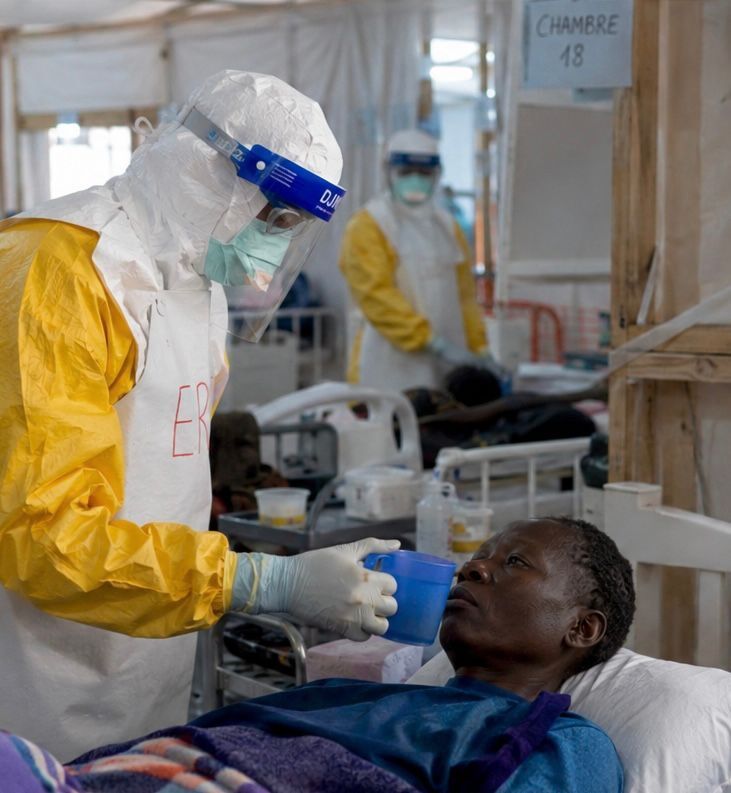
Healthcare workers depend on strict personal protective equipment protocols to minimise exposure risk.
Treatment for Ebola remains largely supportive. Patients receive intravenous fluids, electrolyte correction, oxygen support, and management of complications while the body mounts an immune response. Early initiation of supportive care significantly improves outcomes.
While monoclonal antibody therapies such as mAb114 and REGN-EB3 have transformed survival rates for Zaire ebolavirus infections, there are currently no vaccines in late-stage clinical development that could be readily deployed during this outbreak. As a result, response efforts rely heavily on classical public health control measures and supportive clinical care.
What Is Happening in Uganda?
On 5 May 2026, the World Health Organization (WHO) was alerted to a high-mortality outbreak of unknown illness in Mongbwalu Health Zone, Ituri Province, DRC, including deaths among healthcare workers. On 14 May, laboratory analysis confirmed Bundibugyo virus disease in eight of thirteen blood samples collected from Rwampara Health Zone.
On 15 May, Uganda’s Ministry of Health confirmed an outbreak following the identification of an imported case a Congolese national who later died in Kampala. A second confirmed case in Kampala was identified the following day.
These two cases, appearing within 24 hours of each other and with no apparent epidemiological link, became a major factor in triggering the international emergency response.
On 16 May 2026, the WHO Director-General determined that the outbreak constituted a Public Health Emergency of International Concern (PHEIC) the organisation’s highest level of alert under international health regulations though it does not meet the criteria of a pandemic emergency.
Notably, this marked the first time a PHEIC was declared without first convening an emergency committee, reflecting the speed and seriousness with which the situation evolved.
Health authorities are particularly concerned because:
- the affected Ituri Province is a commercial and migratory hub linked to mining activities and bordering both Uganda and South Sudan
- the region is experiencing ongoing armed conflict and humanitarian instability, complicating outbreak response efforts
- the high positivity rate in initial samples eight positives among thirteen tested suggests the true scale of transmission may be larger than currently detected
- there are no approved medical countermeasures specifically for Bundibugyo virus disease
Should East Africa Be Worried?
Concern is appropriate. Panic is not.
The WHO has advised against countries outside the immediate region imposing travel or trade restrictions, and the PHEIC declaration reflects operational complexity and the need for coordinated international support rather than evidence of high global risk to the general public.
Uganda is not entering this situation without experience. The country has managed multiple Ebola outbreaks since its first major outbreak in Gulu in 2000 and has since developed surveillance systems, infection prevention protocols, laboratory capacity, and cross-border coordination mechanisms.
The confirmed Kampala cases are currently being managed under appropriate containment protocols, with contact tracing efforts already underway.
What happens next will depend largely on:
- speed of case detection and laboratory confirmation in the DRC
- effectiveness of contact tracing across affected health zones
- cross-border coordination between the DRC, Uganda, and South Sudan
- access to conflict-affected communities
- public trust and community engagement
- international logistical and financial support
Outbreaks are rarely defined by the virus alone. They are shaped by healthcare systems, political coordination, public trust, and how quickly communities and institutions respond under pressure.
Understanding Ebola matters just as much as fearing it.
References
- World Health Organization. Ebola virus disease. WHO. Accessed May 18, 2026.
- World Health Organization. Ebola disease caused by Bundibugyo virus, Democratic Republic of the Congo and Uganda. Disease Outbreak News. Published May 2026.
- World Health Organization. Epidemic of Ebola disease in DRC and Uganda determined a Public Health Emergency of International Concern. Published May 17, 2026.
- Branswell H. WHO declares Ebola outbreak an international public health emergency. STAT News. Published May 17, 2026.
- McPhillips D. What we know about the latest Ebola outbreak after WHO declares global health emergency. CNN. Published May 17, 2026.
- London School of Hygiene and Tropical Medicine. Rapid reaction: Ebola outbreak in DRC and Uganda. Published May 17, 2026.
- Coalition for Epidemic Preparedness Innovations. Bundibugyo virus: what it is and what it is not. Published May 2026.
- Roddy P, Colebunders R, Jeffs B, et al. Clinical manifestations and case management of Ebola haemorrhagic fever caused by a newly identified virus strain, Bundibugyo, Uganda, 2007-2008. PLoS One. 2012;7(12):e52986.
- Towner JS, Sealy TK, Khristova ML, et al. Newly discovered Ebola virus associated with hemorrhagic fever outbreak in Uganda. PLoS Pathog. 2008;4(11):e1000212.
- Africa Centres for Disease Control and Prevention. Africa CDC calls for urgent regional coordination following Ebola virus disease outbreak. Published May 15, 2026.